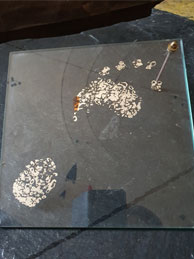
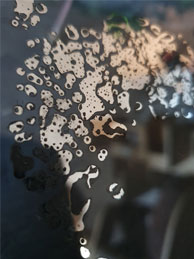
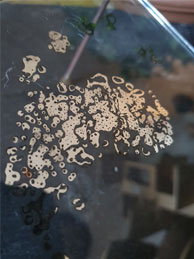
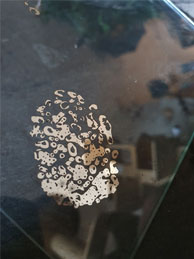
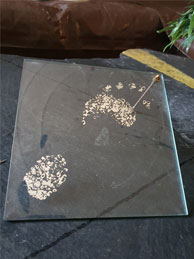
I left the imprint of my left foot on a square mirror tile, through a laborious procedure that involved etching techniques to remove part of the silvering. The technique I used was quite amusing and certainly the most experimental part of the whole operation. This work paved the way for a Way of the CrossI carried out soon afterwards, in 1993, using the same technique; it is now hangingin the chapel of Cava di Melis, in Calabria. The choice to bring a footprintin the world of art was fun: a foot, the appendix that supports the human body and allows its mobility replaces here hands as a symbol of the creator (of art making). The accent moves from doing to being, from hand making to trampling. Hands no longer make, whereasfeetassertthemselves instead. In this footprint (Heraclitus' phrase clarifies and evokes) one can find the entire universe. The causes and conditions that led to the creation of the work are my spirit of research and my desire to experiment with new techniques beyond my known world. The position from which I started inwardly was actually deeply "rebellious": the rejection of any model. The mirror - reflecting material, one of the hardest and more fragile at the same time - lent itself to beingan interesting basis on which to work. The challenge was twofold: on the one hand, to obtain an imprint that was precious and in which imagination could “lose itself”; on the other hand, to be able to remove silvering in certain parts. Just as alchemy emphasizes the process of inner transformation in order to achieve the physical transmutation of metal into gold, so in making art it isa technique in this case that takes on a central and creative role. The process I used was complex and indirect. What I reached in the end was an essence. The content of the work is the wonder in front of something known that becomes infinitely unknown, the immersion into a world that oscillates between microcosm and macrocosm. What is original in the work is on the one hand the chosen subject (contrastingdeeply with the handprintsin prehistoric caves), on the other the technique I used. Within my life, this work, that cannot be defined as a painting nor as asculpture,takes its place on the one hand as experimentation, on the other as an operation poised between two worlds: that of the sun (a high, ethereal, airy, bright, free world) and that of a foot (a low, carnal, closed, dark, forced world). Both worlds reflect my personal condition crushed by suffering, although tending towards freedom and emancipation. My tendency to be dissatisfied with what I have at my disposal, to experiment was born - I believe - frommy rejection of parental models. The profound decision to be different from all members of my family of origin, to challenge the values on which they based their lives put me in a "subversive" position, a position where I put myself seriously at stake with all my abilities. I believe experimentation (accepting experiences) has becomemore and more fundamental as I am proceeding with my path. Refusingwhat is commonly taken for granted pushes me to look elsewhere, to throw myself into the unknown and the uncertain rather than to settle for the known and the certain. In thepast, I made precisely this kind of choice when I decided to look thoroughly at myself inwardly, to take nothing for granted, to be always hundred per cent involved in what I am doing. I realize now I made “subversive” choices: living alone in the mountains at fifteen, working and studying in London at eighteen, leaving my partner after seventeen years, enrolling in English university in English when I was over-forty, rejecting the path that my father had paved for me, working as a car mechanic at fifty. Those decisions required a good deal of courage, initiative, and energy.