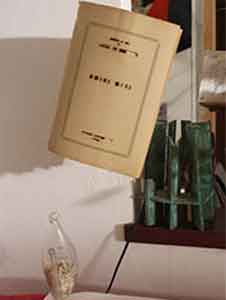
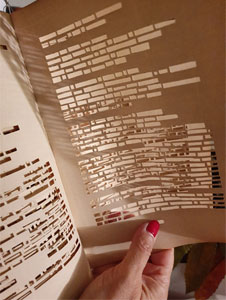
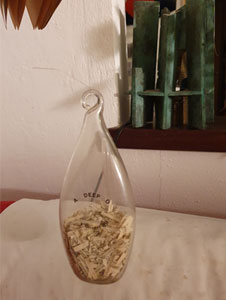
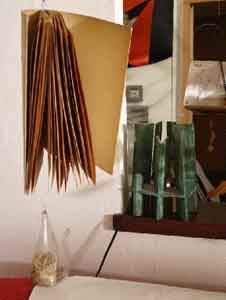
I specially chose abook in abookstore for its feature of being printed only on the front of each page. I was amusedwhen I considered that the author took the trouble to think, write and publish that text with the intention to communicate, putting the words in a certain sequence so that they were given a precise meaning, whereas I separated the words from their original support and order. I cut out, one by one, all the words in the book, leaving the empty rectangles on each page, in order to testify to their absence. The book thus acquired a new look. Emptied of its words, it remains materially full of voids. The bookis hanging from the ceiling so that it can freely tilt, and I hung a glass container to the book,haphazardlycontaining all the words I had detached. The words, although they had some precise meaning originally,are now mixed in the container, devoid of logical connections, detached from their original sense, deprived of the relationships and order that someone had imposed on them beforehand. The umbilical cord of a slender transparent thread (symbolizing thought) now binds book and words together. At the same time, literature acquires a "physical" appearance that it did not previously possess. The title, which in English indicates a deep circle, a deep zero, a deep "O", refers to the circularity of the operation I accomplished: the cancellation/creation of meaning. It is also a homophone of "Oedipus"(the solver of the enigma of the sphinx, who found the hidden meaning in its question). In this sense, the book has lost its meaning on the one hand, but has acquired a novel meaning on the other. From an emotional point of view, this work manifests a state of profound loss of identity on the part of the author: someone else had thought of the original text and I completely nullified its meaning. On the other hand, there is also an equally profound acquisition of identity: the object eventually finds a new meaning. The search for my individuality - after the cancellation of personality I felt my family carried out - led me first to erase all value acquired from both education and experiences; only then could I build new, strictly personal values, with a broad, universal perspective. The causes and conditions that led to the creation of the work are my love for books and words on the one hand and the loss of identity associated with family experiences on the other, combined with a distrust in the ability of the word to "mean" in an absolute sense. The content of the work is words; in this case, words written in black and white to sanction an immutable and universal truth. After my classical, linguistic and academic studies, I increasingly felt that everything that had been said and done before - especially in the art world - was somewhat limiting. None of the paths pursued by the painters I had encountered seemed to me interesting enough, with the exception of the wide-ranging path opened by Marcel Duchamp. I therefore let my intimate life (my "illness",one maysay) into the work of art and the book into my emotional life in turn. What is transient in the work are words, which areinvalidated in their power to mean in context with other words. What is original is,on the other hand, the physical, concrete power that stems from wordsin relationboth to their absence in the case of the page with empty rectangles, andto the unlimited potential contained in the random mixing of words inside the glass container. This work definitively sanctions my detachment from logos. For years, I felt ill at ease with big words, intellectualisms that made me feel inferior, incapable, and culturally stupid. I thought I was not able to think properly, especially in everyday relations with my intellectual and rational boyfriend of the time. With "A deep O" I declared that words - of which I had great awe at the time-showanabsence (of the real thing) and possess a physical aspect that has nothing to do with intellect other than by the traverse, ironic and light ways.