

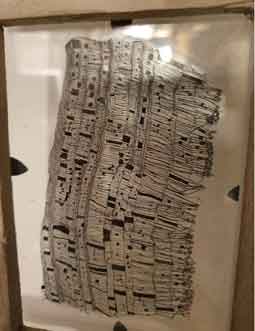
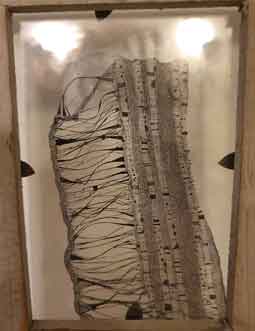
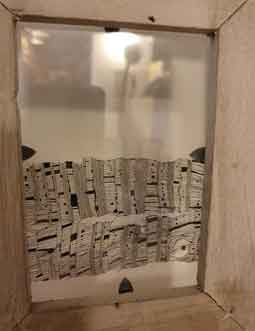
The material, with which I worked many times, is a very feminine and intimate element, which denotes – after many denials – the acceptance of my condition as a female: women's tights. I intended to bring the ladders accidentally produced on tights to their extreme conclusions, obtaining an embroidered and ephemeral surface, a thin and fragile lace enriched with“improbable architectures”. I deconstructed the material in such a way as to produce a texture that was not previously detectable, revealing its structural frame. In such deconstruction, the tightgained an appearance that it did not have before, an abstract look consisting of perpendicular lines that intersect according to random patterns. I "froze" the material thus obtained on a transparent medium that left its fragile substance intact. Ladders designate something that is collapsing from its original condition of integrity. They disclose the internal structure of the material they are made of; the soul of tights is revealed, so to speak, as in a denudation process. In it, a truth, an originality lies. Stripping, subtracting, revealing are actions going deep to the core, they are profound actions. In some circumstances, I used ladders as a screen, for example in the case of the top of "Me-tot". WhenI was an art student, I had inserted small ladders in various boxes, so that natural or artificial light cast shadowson the background; I called them "Pocket Shadows." The first production was strictly black, as if to cancel the original generality or personality of the tight and give it a new identity; later, I added a few coloured interventions (strictly using primary colours). I also painted some ladders white and hung them directly on a white wall, in order to create a thin, inconsistent, ethereal skeleton. My need to deconstruct, to get to the essence is a legacy of childhood, when I liked to disassemble objects in order to reveal their internal functioning, their soul so to speak. Such need, initially born out of curiosity, was later adapted to my feeling: to my self-destructive attitude towards my life, to mydenial of my own personality. The particularly unemotional and punitive family environment in which I lived heavily weighed my life down. With the beginning of my "human revolution" - activated by Buddhist practice - making art became a much more conscious, intimate and profound exploration of my life. Ladders somehow anticipated the inner path I have accomplished with Buddhism, which through a complete deconstruction of myself allowed me to reach an essence on which to build the foundations of my life. The thin horizontal and vertical threads left after the deconstruction of the tight represent a minimal and primary structure on which a rhythm, a beat, a cadencecan be built. My femininity - which I had despised so much I had emblematically denied it in my own life - proved more powerful than my destructive impulse, materialising in a creative vision of femininity as an ability to go deep and to embrace (in this case accidental ladders within the creative process). The causes and conditions that led to the creation of these workswere on the one hand the fascination that ladders have always exerted as signs of "imperfection", of structural collapse;that leads me back to the imperfections and limits of the human condition as such. On the other hand, working precisely on imperfections (deconstructing) drove me to erect fantastic textures that show their own fragility and beauty, as if to state that from the “poison” of imperfections you can draw the “medicine” of hidden meaning lying behind every suffering. Ladders have accompanied me on my path for a long time. Their content, so to speak, is the fragility, the impermanence of all things in this world. It is precisely in such fragility and impermanence that the meaning of existence lies. What is transient in my works with ladders is the shape of each ladder, in itself unique and unrepeatable as any living being. What is original is treating each ladder as a network endowed with meaning and life of its own. Ladders have taken on an important symbolic significance for me. Firstly, of imperfection as an existential condition necessary to build something of value(from slime white lotus flowers, symbols of purity,are born – from suffering redemption and a sense of mission can be built). Secondly, of random and natural architecture, without design or intentionality on my part and yet rich in evocations.
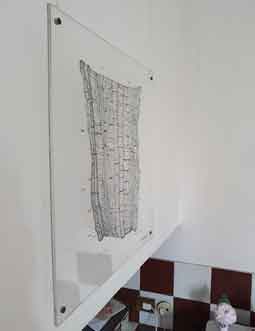
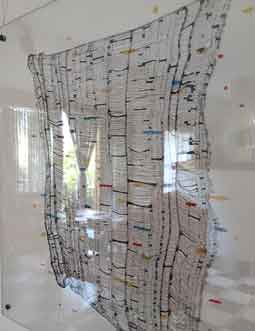
Le calze smagliate in qualche modo precorrono il percorso interiore che ho compiuto con il buddismo, che attraverso una decostruzione completa di me stessa mi ha permesso di arrivare a una essenza su cui poi edificare le fondamenta della mia vita. I radi fili orizzontali e verticali rimasti dopo la decostruzione della calza rappresentano infatti una struttura minimale e primaria su cui poi poter costruire un ritmo, un battito, una cadenza. La mia femminilità - che avevo disprezzato tanto da negarla emblematicamente nella mia vita stessa - si è rivelata più potente del mio impulso annientatore, concretizzandosi in una visione creativa della femminilità come capacità di andare in profondità e di accogliere (in questo caso la smagliatura accidentale all’interno del processo creativo). Le cause e condizioni che hanno portato alla creazione dell’opera sono da una parte la fascinazione che mi hanno sempre procurato le smagliature delle calze in quanto segni di “imperfezione”, cedimenti strutturali che mi riportano all’imperfezione e ai limiti dell’essere umano in quanto tale. Dall’altra il lavorare proprio sulle imperfezioni (il decostruire) mi porta a erigere delle trame fantastiche che hanno una loro propria fragilità e bellezza. Come a dire che dal veleno delle imperfezioni si può trarre la medicina del significato nascosto (dietro a ogni sofferenza).
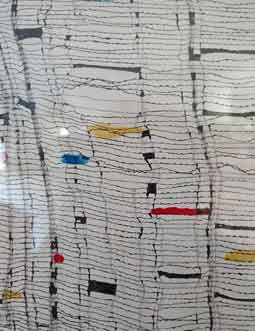
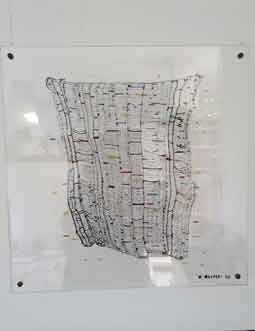
Le calze smagliate mi hanno accompagnato nel mio percorso per un lungo periodo. Il loro contenuto per così dire è la fragilità, l’impermanenza di tutte le cose a questo mondo. Proprio in tale fragilità e impermanenza si trova il significato dell’esistere. Ciò che vi è di transitorio nelle opere con le calze smagliate è la forma di ciascuna smagliatura, in sé unica e irripetibile come ogni essere vivente. Ciò che vi è invece di originale è il trattare ogni smagliatura come un intreccio dotato di senso e vita propria. La smagliatura ha assunto per me un significato simbolico importante. Prima di tutto di imperfezione come condizione esistenziale necessaria a costruire qualcosa di valore (dalla melma nascono i candidi fiori di loto, simboli di purezza – dalle sofferenze nasce il riscatto e la missione). In secondo luogo, di architettura casuale e naturale, senza progetto o intenzionalità e tuttavia ricca di evocazioni.