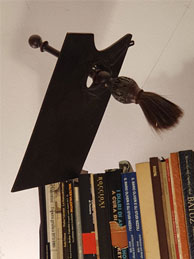
Attempting to "emancipate" all objects characterizing the painter's craft (palette, brush, colours, canvas, easel), after using a canvas in "Natures" and colour tubes in the three "Voyeurs" I chose to emancipate the palette I had used during my studies at the academy, giving it a new opportunity. I blackened all parts of it, including the irregular layers of oil colour that had been laid there; in this way, I somehow denied those colours whose presence can only be guessed because of the irregularities on the surface of the support. A bird trap, located over the hole of the palette, is catching in its grip one brush, also blackened. Thework suggests that the use of subjective colours (not native to objects) constitutes a trap, that the more the artist's choices are subjective and gratuitous, the more they constitute a deception, a refusal of responsibility on the part of the artist with respect to the creative act in its purest, wide andhigh sense. It is easy to "force" our choice on an object, more difficult to respect it deeply and leave one's little self out of the creative act. In my works, I make an effort to respect objects, to intervene as little as possible on decisions, on choices in a subjective and gratuitous way. For this reason, I am prone to accepting both chance and native colours, in an attempt to elevate objects spiritually. "Since generals..." is the spiritual affirmation of my rejection of subjectivity and the artist's personal touch as a valid criterion for creation. Subjectivity is but a trap that frames the little self and prevents the great self from governing the creative act. Ultimately, subjectivity moves away from what Duchamp called the "art coefficient", that is, "the subjective mechanism that produces art in the raw state, however bad, good or indifferent it may be". Sucha decision to abandon what is arbitrary in the decisions involving the creative act, on the one hand cuts the work from the aesthetic, sentimental, personal "impositions" to which a large part of the history of modern art has accustomed us. On the other, it places the figure of the artist as a cold witness of the transformation of objects into bearers of “different” meanings. The creator can then leave the object free tobe born again like a phoenix from its own ashes by intervening only in a "dry" and marginal way. The causes and conditions that led to this work can be summed up in the rejection of the "retinal" painting so despised by Duchamp. The intent of the object is not in fact to please or to gratify, but to inspire thought and spirit. At the foundation of this work liesa distrust in the ability of painting to fully expressphysical reality or to interpret it satisfactorily. On the other hand, the work proclaims the independence of art from the constraints of likelihood and subjectivity. What is transient in the work are the shape and size of the palette, the brush and the trap, or of the traces of colour. What is original is on the one hand the concrete and pure reality of palette and brush detached from the material of which they are shaped, anonymized by the black colour in which they are covered. On the other hand, the energy released by the interaction of the elements that make up the work sets a series of possibilities in motion and makes the work itself alive. My tendency to blacken the native colour of objects in order to make them "absolute" stems deeply from the emotional nullification I felt in my family. For decadesI have systematically cancelled my feelings, unable to legitimize them because they were disregarded by my parents. Not listening to my feelings was the method I chose so as not to suffer the devastating reality that I was experiencing inwardly. Objects have also often undergone the same cancelling treatment I felt within. In addition, blackening (or whitewashing) served to erase the previous history of objects, their past life so to speak. In this way,a new life becomes possible for objects.