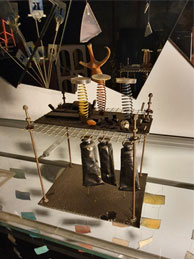
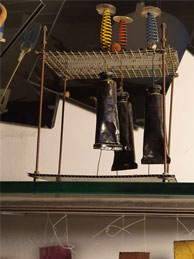
Unlike the upper part of the work, the lower part is a strictly masculine universe. It consists of a black plastic base on which four columns, madeof threaded metal,rest. The columns support a metal grid "roof" on which a blackened electronic board is fixed. Within the space thus outlined, three oil-colour tubes rest. They are painted black, each pierced longitudinally by a metal rod of the primary colour corresponding to the content of each tube. The interiority of the voyeurs shows itself only in the colour of the rods that pierce them, nothing leaks from the internal content of the tubes other than this simple indication of colour. In fact, the masculine rarely reveals his own interiority as the feminine is accustomed to do... The three rods pass through the upper grid and through the electronic board resting there and twist into rounded spirals, which first widen and then narrow, almost for an afterthought. In addition, to the upper end of the spiralsthree shrinking (concave) lensesare fixed. The placement of the three voyeurs directly below the danseuse would allow them to enjoy an excellent view – however reduced – of the dancer. The three lenses, however, move the image away instead of moving it closer... The inability of the voyeurs to approach the dancer is – as in the Great Glass – an existential condition between masculine and feminine, after all. The causes and conditions that led to the creation of this work are the awareness of a permanent division between the male and female universes and the attempt to characterize each world according to the two dominant logics: the graceful, mobile, upward-looking feminine; the static, heavy masculine, with his feet well planted on the ground. At the time, I was still living with my intellectual boyfriend;however, I would soon leave him for a long period of deep meditation on myself. The work is the result of the intense malaise I felt in the relationship between the two sexes, and it represents an effort to find something positive and harmonious in each universe. This is how the feminine turns out to be light, aerial, open, bright and rich in nuances; the masculine, on the other hand, reveals itself as static, closed, limited and above all myopic – although its efforts are after all praiseworthy. What is transient in the work is the formal aspect of both components, which could have been completely different without prejudice to the distinctive characteristics of each element. What is original is the approach to the relationship between genders, a relationship with no hope of union, an attraction without deep involvement, a constitutional impediment. At the time of the creation of this work, I became aware that what I had invested in my liaison with my boyfriend were illusions and desires, and that the reality of that relationship (which I had desperately tried to accept for a long time) implied a lack of respect and consideration for my deep needs. Misunderstanding, lack of encouragement and appreciation had indelibly marked that relationship that lasted seventeen years. Now it was time to give up illusions and desires and focus on my inner reality.