

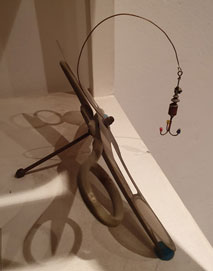
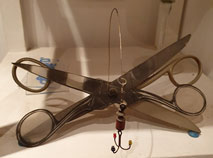
The ancestor of my "emancipated objects" is an open scissors, which I freed from its two-dimensional state by equipping it with a "foot" that crosses it in the centre and that allows it to rise and reach three-dimensionality. In addition, I also equipped it with a "double": its photocopied image on transparent acetate joins the body of the scissors in the centre where the "foot" is also fixed. From the central section, where the rear "foot" engages, a metal portion of circle juts out in front; at the end of this arch hangs a small fishing tool with three hooks, each with a series of beads of a primary colour, as a bait. The scissorsthusgainsan existence different from its common use: its function as a cutting tool is deniedfirst by the very arrangement of the object, whose tips are no longer instruments of offense, on the contrary they are used as supports; and then by its "alter ego" in plastic material, arranged with the tips at the top. The result is a double "X", which suggests the female chromosome (on the other hand, the scissors is female in Italian), or else an intersection where one cannot distinguish the sharp object from its copy. The scissors - well planted with its feet on the ground - through the metal extension with the hooks that acts as an antenna, opens up to welcome the world with its infinite colours represented by the beads bearing the three primary colours, matrices of all possible colours. The new condition of the scissors represents a qualitative leap forward, an emancipation from the role to which it was relegatedin the past. Now it stands upright and opens to the world, it is equipped with a sexual identity (it is female), a double personality (its photocopy) and even tools to interact with the world (the antenna that collects information about the environment). It has thus become in all respects adult, responsible, receptive. Scissors has always been a fascinating object to me, not only for its function of severing (symbolically the umbilical cord that binds me to my parents and family of origin), but also for the crossing of the two blades. It is a case of "two but not two", or of "different bodies but one mind" to put it with Buddhism. It is obvious to consider how a single blade proves useless and inefficient, while the union of the two blades produces something highly useful and efficient. Introducing this scissors into the art world was therefore a way to make a technology - designed to be highly productive - useless and inefficient. The doubling of the scissors also emphasizes a gender connotation that only respects and reinforces the female gender of the term "scissors" in Italian. The content of the work is emancipation, standing up on one’s own, freeing oneself from previous roles and limitations. Therefore, it represents a real "human revolution" of the scissors, which transforms its life radically from a simple extension of man’s hand to a being endowed with its own (emotional) life. Again, the appearance of the object is transient: changing the shape of the scissors or its size does not change the result. What is original is the transformation generated into an artefact that existed well before I chose it: I did not decide its shape, colour or appearance. I refrained from taking any decisions about the object that were not - closely and emotionally - linked to its emancipation. Eventually, I just provided it with an upright station and an antenna to capture the world, so it is now able to relate to it on its own... In fact, creating this work gave me a great hope: that I too, like the scissors, possess the qualities required to carry out my "human revolution" and am perfectly able to carry onmy dynamic growth. If the scissorshad succeeded in emancipating itself, I too would be able one day to elevate my condition and become happy...