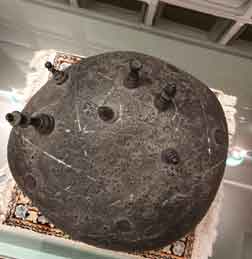
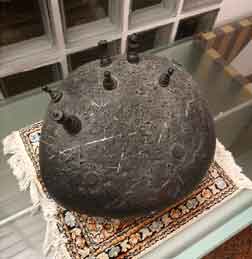
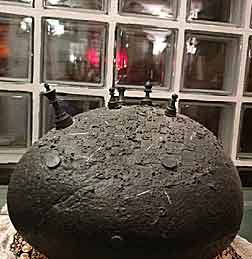
The protagonist of this work is a stone, an element linked tothe ground that gave birth to it; the title declares that the stone connects with what is underground, chthonian. It expresses its desire to rise from its condition of heaviness and agrees to become a chessboard first to enrich itself with a mental connotation and then to rise in stature through the pieces of chess;in such desire its “emancipation” takes place. The blackened rock surface becomes an irregular board - through the alternation of smooth parts and grainy parts - and houses the black chess pieces that populate it irregularly and rise in the three-dimensional space around the rock, expanding it. The curvature of the surface causes the pieces to place themselves obliquely, perpendicular to the surface of the rock, like the hair of a punk youngster. Silver leaf threads mark the surface of the stone as traces of an instant and dazzling celestial passage. These celestial prints provide the rock with a "noble" birth, making it the medium term between earth and sky, low and high. What is found underground can be the means for reaching the divine; a stone can be endowed with spirit. In addition to acquiring a spiritual compass, this stone, although belongingoriginally to the earth, has now the right to a mental field (the game of chess). Rock and chess pieces are uniformly painted black: there is no more competition between blacks and whites, but only a peaceful coexistence in the world (much more than humans can do!). The cause and condition that led to the creation of the work are the love for a heavy stone foundby chance on a trip; I forced my boyfriend of the time to take it to Milan in the late 80s and I immediately used it as a blackened chessboard. Over time, the chess pieces had largely detached and the surface of the rock was ruined. After more than thirty years, I felt the need to "restore" it and at the same time to "emancipate" it further. I made the chess pieces removable through a series of magnets, repainted everything in black and added the most important elements allowing the emancipation of the stone: the silver filaments, signs itbelongs to a "high" and aerial world, which contrasts its being a heavy of stone. The interaction between heavy and light, between earth and sky ultimately represents the content of the work.After thirty years of silent meditation, the rockhas finally taken shape in an effective and fruitful union of earth and sky, body, mind and spirit. What is transient in this work is the stone itself, a chance encounter between a human being and an object wanting to emancipate itself. What is original is, on the other hand, the energy that the stone both receives and emanates from its belonging to the mental world represented by chess and to the spiritual world represented by the silver traces. The fact that even a heavy and bulky insentient object such as a stone can be the keeper of something mental and spiritual is evocative that even a human being weighed down and saddened as I was at the time of our encounter can become light and aerial in spiritual terms. After all, emancipating the rock from its initial condition went hand in hand with my emancipation from suffering and emotional dependence.